Blog: Part 1/2
30 city officers from the municipality of León (México) carried through a QGIS-training to level-up their geospatial knowledge across sectors, within the different municipality departments. As any city, León needs to resolve geospatial challenges that it’s almost 1 and half million residents demand. For these municipal officers, QGIS is a powerful tool that’s capable of breaking down those geospatial issues that the officers work on.
These officers are studying online on our GispoLearning E-Learning platform, to become QGIS experts and to build their understanding of the underlying basic concepts from Geography and Geographic Information Systems (GIS). They have learned to, for example, digitize city areas from aerial imagery or make some intersection spatial analysis between two geospatial datasets.
Learning together is a great tool for creating bridges between different municipal departments and the actual officers: GIS Coordinador at municipal urban planning office IMPLAN León, Wendoli Jiménez Garza, comments that the present administration has worked hard to create synergies between different departments (in regards to the GIS work-flows). She adds that the ongoing QGIS-course has strengthened the commitment to shared objectives thanks to learning together and sharing knowledge. The students represent widely the municipal government by means of the following departments:
- Urban Municipal Planning Office
- Office of Information Technologies
- Office of Urban Development
- Water supply and sewerage systems
- Cadaster
- Office of Rural Development
- Office of Public Works (Construction)
- Municipal Institute for Housing
As said, during the course, students are able to share insights by addressing questions (among the group) to the instructors in the course platform.
Students deliver also more than requested. Learning QGIS is something that the students seem to enjoy. For example, map making with the always-so-great Map Composer -tool of QGIS has proven to inspire learners to carry the learning beyond the minimum goals.


This is Fedja. Fedja is a 3-year old, happy, friendly, and fluffy Samoyed, who loves long walks and (because of the not-so-distant history of Samoyeds as sledge dogs) needs a lot of exercise. Fedja is lucky enough to live near to a natural reservation area, and to have an owner who also loves to go outdoors. That is me.
Every day in the afternoon, after a day in the home office (Fedja is a great foot-warmer, too!) we go and explore the nature.
After three years of these daily walks I still try to find new routes and places to see, and today, on one of the most enjoyable walks across the spring forest, I started to think how I actually decide where to go. How do we hoomans understand our surroundings, and what are the attractions and no-go zones of a (dog) walk?
DESIGNING ROUTES WITH FEDJA
Our neighborhood is very heterogeneous. If I draw a circle with a 2 km radius around our house, it holds three lakes, a river, a small hill with a slalom slope, forests, fields, and quite active residential area with its services (including the hospital where I was born). It is like a Carcassonne table game in real life. Every day I can choose where to go and what kind of things I want to see. Still, it seems that there are some routes that attract me regularly, while others are very rarely explored. Why is that?
Of course, having a dog with me puts some requirements. The route must visit some of the public trash cans because we need to pick up all the dog litter. Then there are multiple other, time- and situation-dependent variables:
- The season. Winter months expand our territory, because we can walk on ice-covered lake. In autumn, our routes tend to visit some very secret mushroom spots on the forest. (I have tried to teach Fedja to recognize the smell of trumpet-shaped chanterelle, but with no success.)
- The weather. The weather conditions have less impact than you could assume, because daily walks must be done anyway. We Finns have a saying: “There is no such thing as bad weather, there is only bad equipment”. But if the roads are very slippery, or there is a lot of snow, it is better to stay on bigger roads. In the summertime, rain can change some small paths too muddy for our coat. I bet you understand. Just look at the picture above.
- The hour. It gets dark quite early in the winter. There are no street lamps in the forest. More specific time is around 2 PM on weekdays, when it is not wise to pass the elementary school, at least if we are in a hurry. I mean, can you imagine a single child who does not want to pet this snowball?
I’m sure that I am not the only one who does not want to use the same street twice during one walk. Actually, when I occasionally record my walks with SportsTracker, I have noticed that my routes are surprisingly round. Crossing my own path once is acceptable.
If the length of our walk is limited, and we stay on paths and roads (except short mushroom nips!), there must be a finite number of routes. And, considering my extensive experience of this area, one could assume that I have tried most of them. It would be really interesting to see how some route optimization algorithm would plan a walk for me. AI has been found to be successful in designing for example user interfaces; it suggests quite unconventional solutions that still are acceptable by humans. Could it also find new aspects to our walks? So far, the route optimization algorithms have been focusing on shortest or fastest route between two discrete points. Wandering around and coming back to where you left might still be unthinkable concept for AI.
After sleeping overnight, I realized that the task was not as impossible as it seemed. The same algorithms that optimize travel time can be modified to prefer good walking paths. I just need to read the road class information from the attributes and make the algorithm to use it when calculating “fastest” route. In road type classification, smaller numbers typically mark higher class, i.e. bigger roads, and vice versa. Then I thought that I still need a programmer to do that, but after a while I also understood that it might, just might be possible for me with QGIS and open data! QGIS offers a wide selection of network analysis tools and a graphic processing modeler, and all the data I need is openly available.
With my almost-forgotten knowledge about algorithms, and with very limited experience of QGIS processing modeler, I sketched a model for finding a suggestion for a dog walk.

CREATING THE MODEL USING OPEN DATASETS & QGIS PROCESSING MODELLER
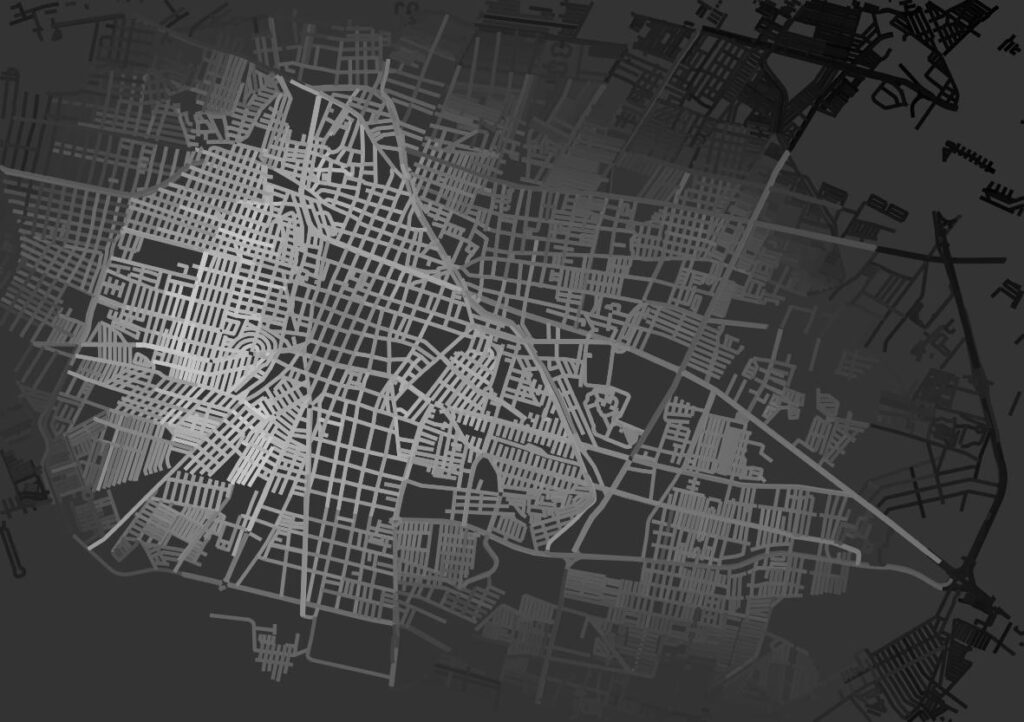
I used the road network of Geographical Database, which is open data from National Land Survey Finland. Trash cans are actually bus stops (but there is a trash can in every bus stop) from OSM. The model still has many flaws; the weather and time conditions are missing, and it does not really prefer smaller roads but simply picks all nicely walkable roads from the bigger road network. It also doesn’t consider the length of the final route. Still I am quite proud and amazed how I could create this in only couple of hours. It looks very impressive, doesn’t it?
The model finds a random “destination” point. Then it calculates the shortest path to that destination and finds the closest trash can along the way. Next, it changes the route so that it goes from home to that trash can and then to the destination. After that, it removes these “used” routes from the network and calculates another route back home. This prevents the same route for another direction. Finally, it combines routes home – trash can – destination and destination – home into a single route.

Tampere began improving the master plan data model as a KIRA-digi trial project in November 2017. The project was chosen as one of the best projects of the funding round and advances the Finnish goverment’s key project to advance the digitalization of public services.
The goal of the project is to produce a national data model. For this reason, co-operating with zoning planners from other cities is of primary importance. The master plan data model is related to the overall process of land use and the development of its enterprise resource planning. In Tampere, the goal is to develop the overall land use process by achieving consistent and fluent data exchange. The new data model also acknowledges international requirements, such as the EU INSPIRE directive.
“We see no reason why this data model couldn’t be an ‘export product’, or even why it couldn’t be used to improve the INSPIRE data model.
When possible, the data model is developed so that it can be used to present data produced in a foreign land use planning system. The results of the project will be published on GitHub and may be freely viewed and utilized over country borders. We see no reason why this data model couldn’t be an ‘export product’, or even why it couldn’t be used to improve the INSPIRE data model”, tells Jarno Kinnunen, leading Senior Planning Officer at the City of Tampere.
In Finland, similar work has also been done on other levels of zoning. Helsinki has an ongoing city plan data model project and the HAME project has developed a data model for regional plans. Meanwhile, the Finnish Ministry of Environment is focusing on national digitalization measures and solutions, making Tampere’s project rather timely. Minna Perähuhta, a specialist of the Ministry of Environment, stated the following on 14.12.2017, in the annual meeting of the Finnish Geospatial Data Network:
– We didn’t think the KIRA-digi project ensemble would include such harmonisation experiments. Helsinki’s city plan data model project surprised us first. The original idea was to collaboratively harmonise projects within the KIRA-digi ensemble. Having harmonisation efforts at such an early stage was a pleasant surprise. We then had the harmonisation of the zoning plan data model project, which was an even more structured entirety.”
With these projects, it’s a good time to look forward to an open harmonised data model and tighter collaboration with other projects.
WHAT’S BEING DONE?
In addition to creating an open data model, the goal of the project is to develop a continuous process for master planning, create a standard for master planning data contents, and provide input for the upcoming land use law update. The data model is developed so that interested parties may adapt the data model as easily as possible. Primary needs are related to streamlining the technical implementation of the master plan and fully taking advantage of technical possibilities. Currently, a lot of overlapping work is being done, and processes which could be automated are performed manually. The secondary goal of the project is to improve the efficiency of the overall land use process.
– Additionally, it’s possible to set an example to improve the efficiency of the overall land use process by “stepping out of the box” and extracting valuable information from the data through the data model, says Jarno Kinnunen.
Through the data model and its development, land use decisions can be made available in a machine readable format. Once these decisions are in a standardised format, they can be easily shared using international geospatial data interfaces and used to develop various services that provide additional value. Other benefits include increased transparency of the general plan design process, improved efficiency of the design process, and improvements in the quality and availability of data produced by the design process. The City of Tampere describes the process:
– In the 2000s, Tampere has focused on creating approx. 20 partial general plans. Developments have been made in the presentation and content of the general plan, and the potential of geographic information system software has been realized. Massive leaps have been made, and the data required to produce the general plan is approaching a situation where the data, which is mostly produced outside our own unit, is up-to-date and of sufficient quality to be linked directly to the object in the general plan. In other words, organisational and technical developments have made the data models possible.
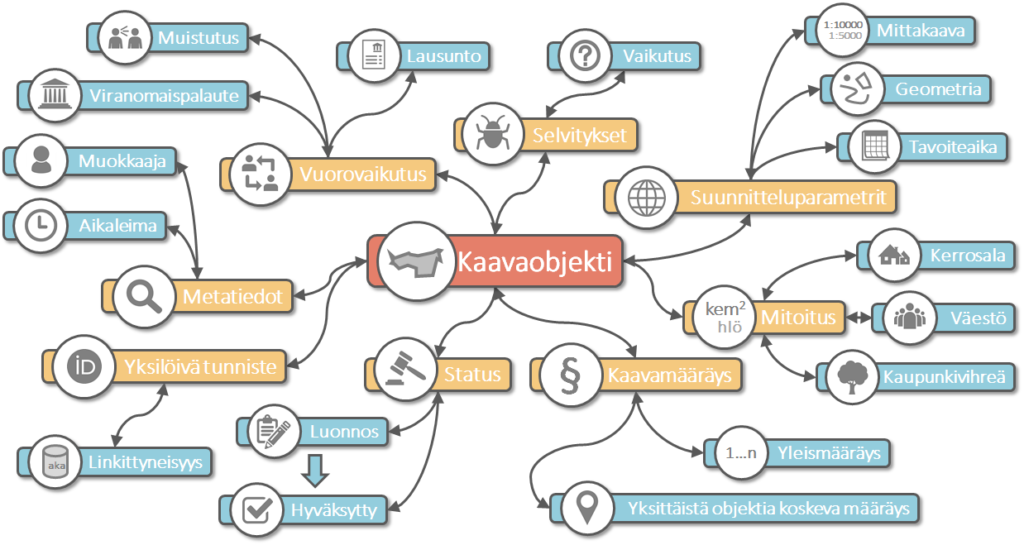
Meanwhile, work is underway to determine how data that is essential to the general plan can be linked to e.g. the city plan, and how this information can be managed. The idea is to use each object from the master plan, such as a residential or recreational zone, as a platform, that can be appended with related information such as clarifications, plan provisions, spatial- and metadata.
Moving forward openly
The project’s key word is openness, as other cities struggling with the same issues can hopefully benefit from the project. Tampere wants to discuss the development of the master plan data model with the planners of reference cities.
“Our initial contacts have seemed promising, and it can be sensed that the same line of thought followed elsewhere”, tells Kinnunen.
The first version of the general plan data model is developed in 2018 openly and following agile development principles. The results of the project are publicly available during and after development and may be freely developed further. The development is done collaboratively by Gispo and geospatial experts of the City of Tampere, and the views and opinions of professionals from other organisations are also taken into account:
– We have previously worked on a city plan data model with the city of Helsinki, so in a sense we know what to expect. Still, the general plan will surely provide its own challenges, that are now being iteratively explored. It’s important to communicate regularly with the client during the data model development and discuss the state and future direction of the project. We want to distribute the data model openly as early in development as possible, so our work is transparent to everyone”, says Pekka Sarkola, CEO of Gispo Ltd.
One of the project’s goals is also to renew the general plan design’s delivery model and to offer ideas for the upcoming land use and building law reform. The project progressess iteratively, with development followed by testing, feedback, and further development.
– During the data model development, welcome changes to the current land use law are identified and documented. Legislative issues with digitalization, such as missing or inadequate land use legislation, are then evaluated in the project’s final phase. The recognized issues will be reported to the Finnish Ministry of Environment at the end of the project, Tampere promises.
Thanks for comments: Head of Master Planning Pia Hastio, City Geodesist Anna Mustajoki, and Leading Senior Planning Officer Jarno Kinnunen, City of Tampere.
More information on the project in Finnish:
- KIRA-digi project presentation: Yleiskaava kehittyväksi tietomalliksi
- 3DYKS – digitalization of city planning, case: Tampere
Related projects:
In 2015, Gispo produced an analysis of potential flying squirrel glide paths for the City of Espoo. The analysis was based on laser scanned data and the results were visualised as maps, which may be used to support city planning and to target fieldwork to specific areas.
Supporting decision making
In a built environment, flying squirrels struggle to find a route from tree to tree. In particular, wide highways without suitable rest areas obstruct the animals’ routes. Digital elevation and vegetation models built using laser scanned data and a specific calculation model were used to identify potential obstructions and crossing points. A model was developed to determine the effect of the forests’ height on the probability of a successful glide from one tree to another. The goal of the project was to support the ability of Espoo’s public administration representatives to recognize the crossing points used by flying squirrels by utilizing digital vegetation and elevation models. The project was awarded second place in the City of Espoo’s innovation competition.
Open data
Data processing, refinement, analysis and visualisation were done using a PostgreSQL database with the PostGIS extension, GDAL/OGR library and the QGIS geographic information system. The City of Espoo published the project’s geospatial data analysis results as open data on the National Treasury’s avoindata.fi web service.
Our role in the project:
- Developing a calculation model
- Implementing the geospatial data analysis
- Processing the data
- Visualising the results of the analysis
Read more (in Finnish): News article on Yle, the Finnish Broadcasting Company
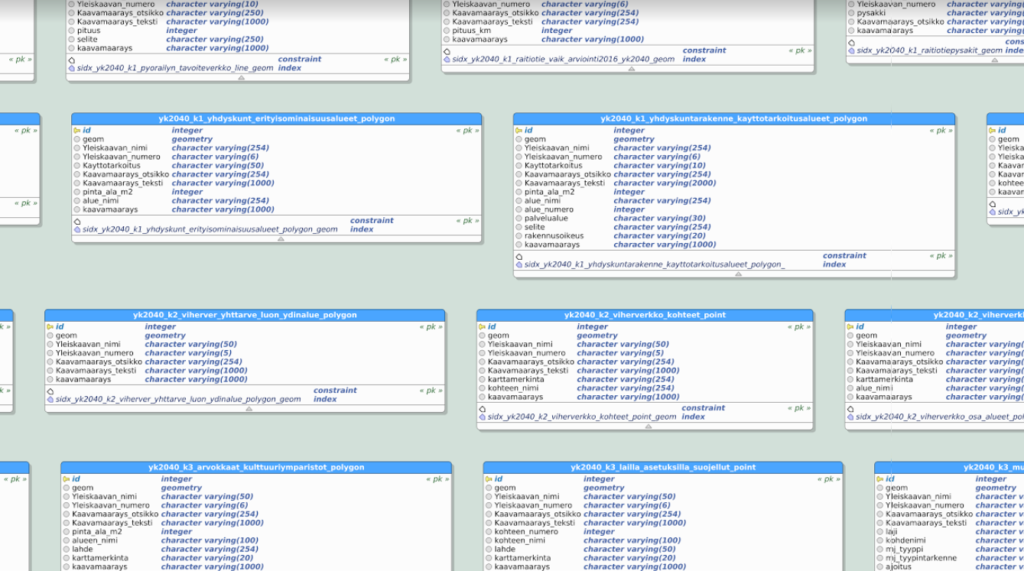
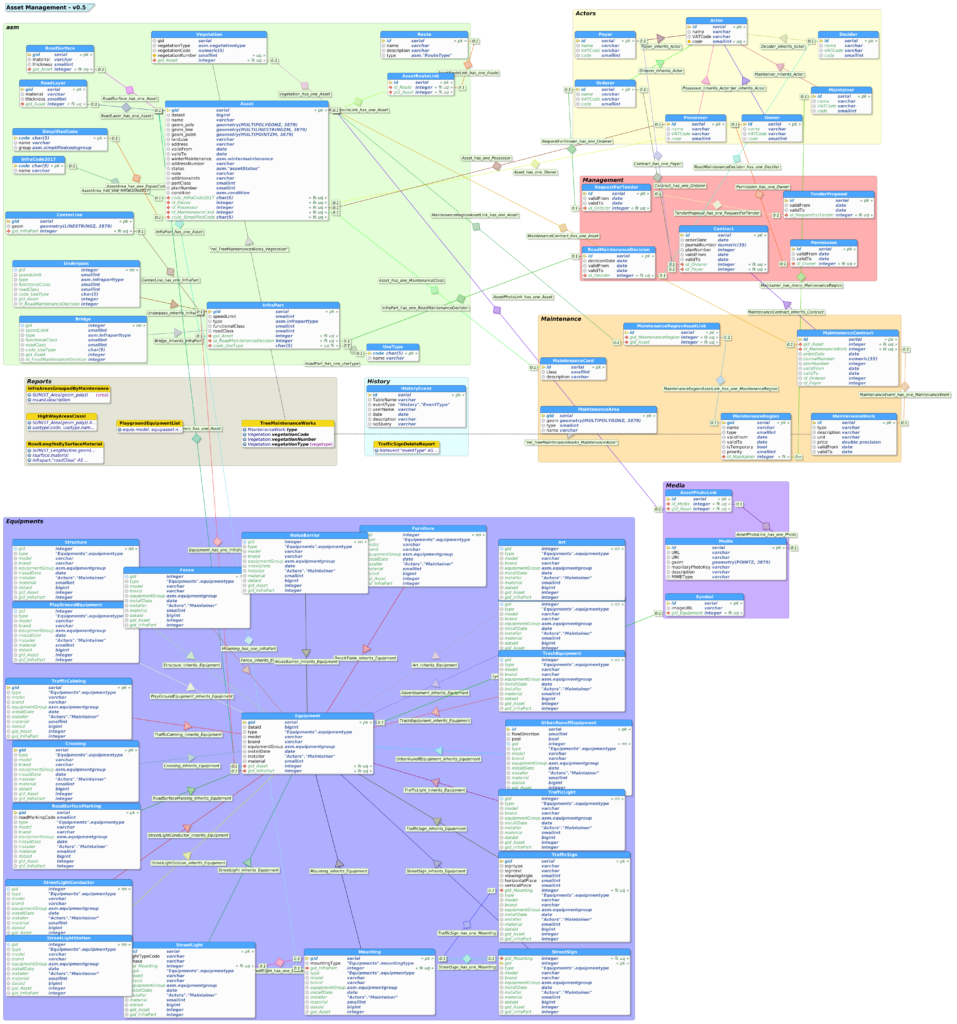
Cities have roads, parks, playgrounds and other infrastructure assets that are maintained, renewed and built on demand. Cities use a geographic information system for various tasks, including analysing the needs of the residents, creating reports and organising maintenance. Data models are an essential part of this system. The City of Espoo’s KIRA-digi funded project “Developing an open source asset management system and its interfaces”, led by Saara-Maija Pakarinen, has examined infrastructure asset data modeling from many viewpoints. The data model has been developed in collaboration with Gispo and designed with pgModeler, a PostgreSQL database modeling software.
Even though public infrastructure asset management affects every citizen, not a single open geographic information system has been designed specifically for this purpose, making Espoo’s project even more meaningful. The data model is published on a GitHub-repository, which also contains the project’s wiki. This makes it easy for anyone to try the data model and contribute to future development.
The City of Turku offered an opportunity to conceptualise and implement applications that benefit the people and organizations of the Turku campus and science park. 16 teams and tens of people accepted the challenge and participated in the competition with a main prize of 8000€. Gispo Ltd. was brought in by Turku Science Park Ltd. to assist and spar the teams. The hackathon was held over the weekend 29.9.-1.10.2017. The longer term goal of the project is to develop the Turku science park area into a vibrant district.
OPEN DATA, 3D CITY MODELING AND AN IOT-PLATFORM
The teams had access to various open datasets, including public transit and event data. The City of Turku also provided access to geospatial data APIs and the 3D model of Turku. Teams were also offered access to the Sova3D web platform and the Elisa IoT platform. As the data used is open, the used datasets are still freely available for viewing and use. A Mapillary capture session, led by Janne Mustonen from the City of Turku, was organized during the hackathon weekend. Gispo has added captured images of the area to Mapillary.
Winning teams
The judges eventually ended up with two winners: Go Questing and TwinCities. The members of the second winning team didn’t know each other before the hackathon, making their achievement even greater. Both teams won 4000€ and got the chance to pitch their ideas at the opening of the Turku Visitor and Innovation Centre in December 2017.
Gispo’s role
The hackathon was hosted and scheduled by Sanna Jokela from Gispo Ltd, while Erno Mäkinen helped the teams utilize open data and the technical platforms. Experts from Elisa, the City of Turku, Regional Council of Southwest Finland and Turku Science Park also guided the teams.
“The Turku Future Hackathon was a successful trial of a new operating model, in which practical work is done directly with partners. The facilitation and success of such events is of primary priority, and Gispo Ltd. has succeeded marvelously.”, says specialist Janne Mustonen from the City of Turku.
“In hackathons, the organizer has a major responsibility in ensuring the event progresses smoothly and there’s a good athmosphere. Sanna handled the event all through the weekend and gave positive energy to competitors and organizers alike. Well done!” -Kalle Luhtinen, Turku Science Park Ltd.
Check out the slideshows and pitches of each team.


In 2018 the city of Helsinki received KIRA-digi funding for the advancement of digitalization in zoning. The “Asemakaavat yhteisenä tietovarantona” (City plans as a common resource) project aims to improve data management in city planning through the use of open interfaces. Helsinki has put an emphasis on the development of city planning data management since 2015. Gispo has supported the city of Helsinki in the adoption of open technologies and wishes to continue their involvement in Helsinki’s projects.


This year, we got to participate in the Land and Poverty 2018 conference organized by World Bank in Washington DC 19.-24.03.2018. The conference gathers Land Administration experts from all around the world to tackle the latest research and practice on the diversity of reforms, interventions, and innovations in the land sector during sessions and panels, besides of workshops and posters. From the standing point of geospatial data, we think that the sector seems to need “It’s all about the basics” way of thinking: globally to achieve some important productivity gains, it is important to invest in the very basic knowledge base and tools to work with geospatial data.
#LandConf2018 starting our journey at Land & Conference 2018. #Geospatial #FOSS4G #GispoLearning with @teamfinlandfi pic.twitter.com/S4PFEyYbCZ
— Gispo (@gispofinland) March 19, 2018
As first-timer at Land & Poverty, especially from the technology standpoint, one was reminded of the huge technological inequalities we have from continent to continent. The shortage of conceptual knowledge and technological know-how seem to be one of the major bottlenecks for the sector to evolve all around the globe.
Although this disparity sticks out in IT sector, today technology can ramp up the productivity issues all around the world. The enhancement of the basic geospatial work processes in the Land administration sector doesn’t require huge investments from the user organizations as it was only a few years ago. The open source geospatial software we got out there, solves just about any use case, there’s in the Land administration sector. Our mission at Gispo is to support this trend with delivering professional training all around the world. We want to make the “Becoming GIS Expert” learning path as easy as it gets: on our remote courses learning results can be equally as good as in a traditional onsite training.
GIS TRAINING DECLARED AS ONE OF THE KEY NECESSITIES IN THE SECTOR

During the conference, we had the possibility to share our work, passion, and knowledge through a and a Masterclass-workshop. You can attend the MasterClass free of charge and try some open source geospatial software and do guided exercise on how to make a “pseudo3D” geospatial visualization of buildings (with QGIS), use a spatial database to examine which are the buildings that have a distance minor to 300 meters from riverbanks of the Nile (with PostGIS) and share some map layers with a geospatial server (with GeoServer).
You should also check out our , which talks about E-Learning as a solution for delivering geospatial education and dives into the learning results we have had from Finland with the GispoLearning-users. This gives a quick view also to the world of open source geospatial software and its pro’s when considering it as a toolset of choice for the land administration geospatial experts.
The biggest payoff from this conference probably comes from the get-together of the experts and colleagues from different parts of the world to advance ongoing and future projects, besides doing benchmarking from other organizations. Land administration sector evolves, and it evolves by people having common needs. The conference gathered almost 2000 persons from public sector (e.g. national mapping agencies), private and civil society without forgetting the World Bank experts
As a geospatial evangelist, one is always eager to hear about the new trends in the geospatial realm and the use cases for the utilization of geospatial data. As to mention some, satellite imagery was definitely a big keyword, besides of blockchain technology increasing its interest in the field. And as a growing trend, open source geospatial software was definitely seen also cross conference discussions as a solution that this sector has taken quite seriously.
Lastly, it’s worth mentioning that we were lucky to be part of a larger public-private delegation from Finland that traveled to the conference: together with Business Finland, other Finnish companies (Spatineo, Iceye, Evolta, Simosol, Niras Finland, Sitowise and Dimenteq), The National Land Survey of Finland and Aalto-University we went to Washingtong to converse and envision on the future of Land Administration sector with colleagues from all around the world.
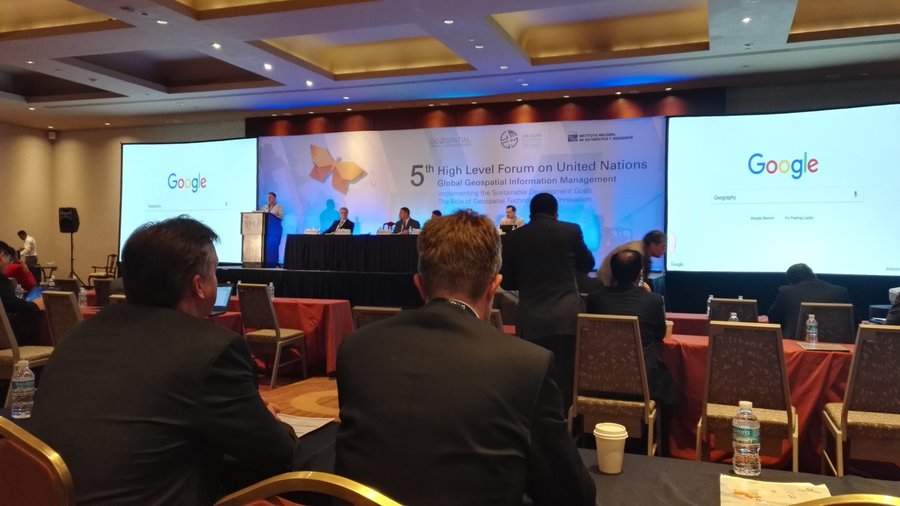
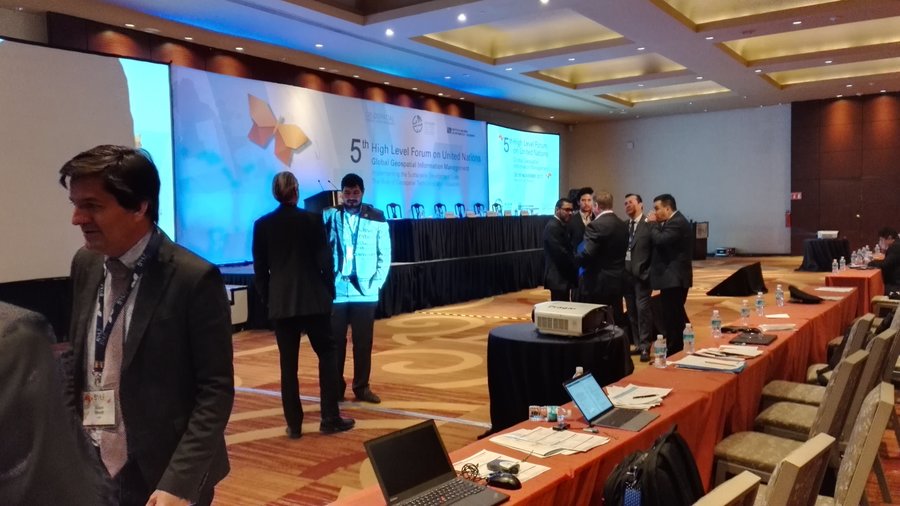
Gispo participated at the Fifth High Level Forum of the United Nations initiative on Global Geospatial Information Management (UN-GGIM) in Mexico City 27.-30.11.2017. We as an expert organization on open source geospatial software solutions were interested on how the international community will leverage open source geospatial technology to empower the member states in their journey working on the Sustainable Development Goals (SDGs) of the 2030 Agenda for Sustainable Development.
“We created a problem: we have too much data” Andy Wild from @planetlabs diving into the binding of #SDGs and satellite data at @UNGGIM #HLF5 pic.twitter.com/n3Hu0IHw9V
— Santtu Pyykkönen (@SanttuVP) 30. marraskuuta 2017
This time the High Level Forum was attended by persons from 74 countries, mainly by the mapping agencies of different member states, but also by private sector and civil society representatives. Finland was also brought up on few occasions in relation to the merits of National Land Survey of Finland (NLS). NLS was mentioned as the 2017-2019 lead country of Artic SDI and as the organization in charge of the development of Oskari, an open source web mapping framework.
During the Forum we got to listen on sector-wide evolving trends in the Geospatial from different major private sector representatives such as Jack Dangermond (ESRI), Ed Parsons (Google) and Andrew Wild (Planet). Few messages in particular were delivered quite unanimously: the amounts of geospatial data is growing as never before, the ongoing growth of computational power is making possible geospatial analytics at a whole new scale and when it comes to the SDGs and the use of geospatial information, the success of the international community and every member state depends on how well the offices in charge know how to disseminate and analyse this
Jack Dangermond #ESRI keynote speaker at opening session of the #UNGGIM High Level Forum in #Mexico. Role of #geospatial Technology and Innovation In Implementing the #sustainable development goals #SDGs . pic.twitter.com/SdRRJxPAUk
— Louis Brown (@loubrown511) 28. marraskuuta 2017
During the conference the forum organizers had guaranteed that there was sufficient time to mingle and share experiences related to the common geospatial challenges. Gispo also got to meet various Mapping and Statistics agencies from different UN member states through their representatives. It was interesting to hear about the geospatial solutions based on open source and/or commercially licenced geospatial software that the mapping agencies in different member states implement.
As we came to the end of the Forum, the participants worked together on the final Declaration of the Mexico City Forum. As one of the key principals throughout the declaration was the necessity for more extensive public-private collaboration schemas to accelerate the gathering and analysis of geospatial information for the SDGs, besides of the shared commitment on working together and supporting, in particular the least developed countries to strengthen the capacity of National Statistical Offices and National Geospatial and Mapping Agencies in their SDG implementation work.