

What is PostGIS?
A spatial extension for PostgreSQL. End of blog post.
Hold your horses! While you could answer the title question with a single sentence, the answer might only raise more questions if you aren’t already “in the know.”
First things first. We need to clear up the concept of a database.
Database – collection of organized information
A database is a collection of organized information. In the past, information was organized physically in paper folders, card catalogs, clay tablets, and other things my children have never heard of. Today, we usually prefer digitally organized collections of information. That is what we call a database in this context.
Organized information, of course, refers to the fact that things are not scattered haphazardly. Instead for example, pictures of the city’s traffic signs taken in the field are saved in the same folder (either digitally or physically) and essential information of each picture has been recorded (location, color, height, meaning, name, etc.). This is how a database is compiled.
Relational database, tables and relations
There are different systems for organizing databases; this is actually what we refer to when we talk about, for example, PostgreSQL, Oracle, or MySQL. We usually call them relational databases, but their proper even though long and clunky name is Relational Database Management Systems, or RDBMS. As you can see, it is a system for managing relational databases.
But what is a relational database? What kind of relations can a database have any way? As you’ve probably already guessed, it’s not about romantic relationships, but something slightly less exciting.
A relational database stores data in tables (rows and columns ). It is between these tables that we find the relations. I told you it wasn’t that exciting…
But put aside your romantic ponderings for a moment. Let’s imagine we have a table for romance novels and a table for authors, we could then establish a relation between the novels and the authors. We’ll assume one author can write several books, and one book can have only one author, then the relation is a one-to-many relation.
To make it more clear, we’ve created a chart:
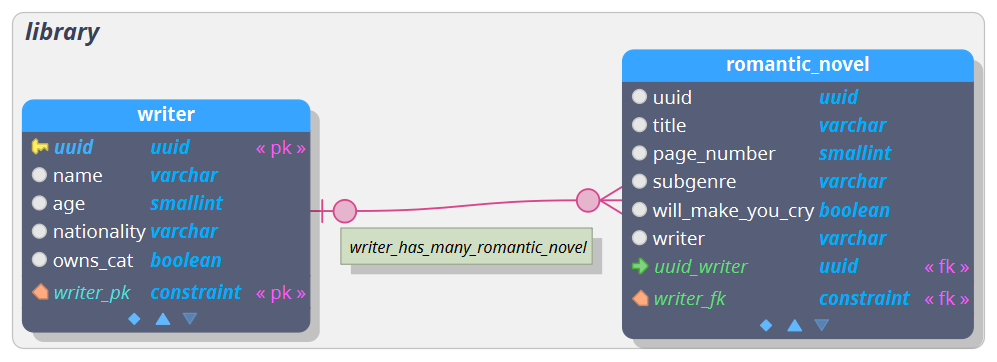
Now we’ve done it! We made a data model! We could use this data model to create database for our romantic library and store information about each book and author.
But we’re not here to talk about novels and relations. We’re here to talk about PostGIS.
PostgreSQL and the spatial extension PostGIS
Okay, so now we know what a relational database is. A popular “relational database system” is PostgreSQL.
PostgreSQL, often called just Postgres to avoid tripping over your tongue, is built on open source and actually turns 30 this year (2026)! It is an established player in the database market. PostgreSQL continues to be one of the most popular relational database systems in the world. Here at Gispo, we are very fond of PostgreSQL, primarily because it is open source and because PostgreSQL has a spatial extension called PostGIS.
Now we have almost reached the answer to the title question. PostGIS is an extension that you install on your PostgreSQL database. Without PostGIS, PostgreSQL is quite helpless when it comes to geographic data. PostGIS enables the smooth management and analysis of large amounts of geodata. You get access to, among other things, spatial formats and spatial analysis for geodata. If this piqued your interest, perhaps you should attend Gispo’s PostGIS course?
Let’s recap!
– What is PostGIS?
– PostGIS is a spatial extension for PostgreSQL
Bonus question:
– Who needs PostGIS?
– Organizations that want their geodata to be neat and organized and easily maintained and analyzed, and organisations that don’t want to pay license fees for their geodatabase.
